
.png)
Everyone is using AI nowadays. According to BCG, 70% of companies experimenting with AI are deploying it in talent acquisition, more than any other HR function.
Candidates are using it too. They’re drafting cover letters, polishing resumes, and rehearsing answers with AI coaches.
On the surface, it looks like progress. PwC’s Global AI Jobs Barometer found that sectors most exposed to AI are seeing nearly five times higher productivity growth. 92% of firms using AI in HR say they’re already seeing benefits.
But that’s only part of the story. Much of the AI being layered onto hiring right now is making the process worse, not better. The people paying the price are both the candidates trying to get a fair shot and the hiring teams trying to find the right person.
The breakdown falls into three areas that account for most of the frustration on both sides.
Hundreds of applications, from the same author.
When everyone uses the same AI tools to write applications, the applications start to look the same. Cheralyn Chok, co-founder of Ottawa-based nonprofit Propel Impact, saw this firsthand: written applications became “increasingly similar” over time, making it “really hard to gauge the quality of candidates.” Pre-recorded video introductions weren’t much better. Applicants re-record them over and over to achieve a polished, but inauthentic result. The more AI and technology assists the process, the less you learn about the actual human.
Optimized for the algorithm, not the job.
AI-savvy candidates can game the system, including the growing practice of white fonting, where keywords are hidden in resumes to trick applicant tracking systems. Meanwhile, seasoned professionals who don’t know how to optimize for an algorithm may never get through the door. Current screening tools reward prompt fluency more than domain expertise. The candidate who is best at AI isn’t necessarily the best at the job.
Faster. Colder. Emptier.
Fully automated video interviews can feel impersonal, even insulting, like being auditioned by a machine with no one on the other end who cares. It feels that way for many candidates and leaves a bad impression of your culture. 65% of candidates say a bad interview experience makes them lose interest in the role entirely. BCG found that 52% would decline an otherwise attractive offer after a negative recruiting process.
A Fairer First Impression
So the honest question we must ask ourselves is, if AI-only is too cold, and human-only is too inconsistent, what actually works?
This is where voice AI has quietly emerged as something neither side expected. A middle ground that candidates genuinely prefer.
Not because AI was better. Because AI was fairer.
Voice AI can’t be gamed the way a written application can. You have to think on your feet and answer in real time. It interviews candidates at whatever hour works for them, across any time zone. It asks every question, every time, with no mood swings and no hallway phone calls.
As Elena McGuire, Director of People and Special Projects at Thrive Career Wellness, explained in a recent Harvard Business Review report, Candidates get to interview without intimidation, at their convenience, and “in that first showing, at least you get a good shot.”
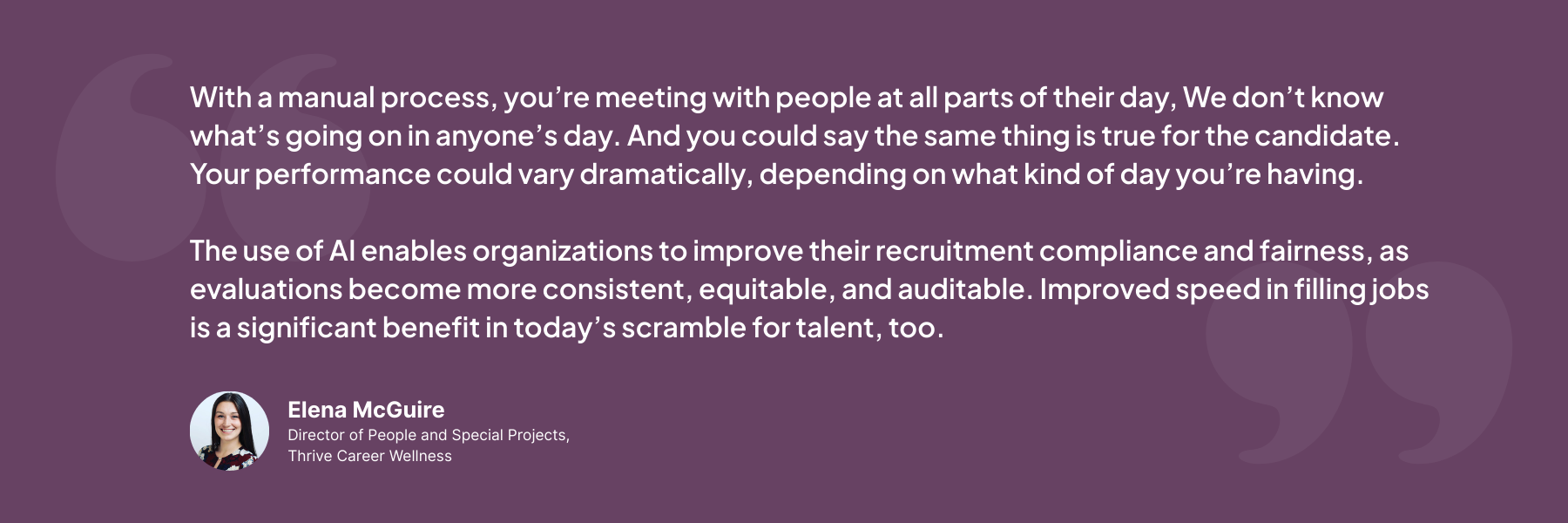
The efficiency gains are real, too. Propel impact went from spending hours vetting a single candidate to recruiting four times as many professionals. Thrive cut “days and days” of scheduling by having three interviewers review the same recorded conversation instead of conducting separate interviews.
Thrive AI in service of the decision, not in place of it
The argument for voice AI isn’t that AI is good. It’s that AI is good when it’s pointed at the right problem. At Thrive, that thinking extends to how we connect employers with candidates. Our Talent Exchange doesn’t use AI to replace recruiter judgment. We use AI to remove the noise before judgment begins.
Skills are parsed, so candidates are matched on what they can actually do. Personally identifiable information is stripped so hiring managers can evaluate capability before demographics. The recruiter still makes the call. AI just makes sure they’re looking at the right people when they do.
Related Articles You Might Like…
- Investing in Employees: The Impact on Engagement, Retention and Perception During Layoffs
- From resistance to resilience: uniting leaders and teams through times of change
- What is Outplacement?
Not whether, but where to implement AI
This isn’t a story about replacing humans with technology. It’s the opposite. Voice AI handles the first conversation so that human recruiters can spend their time where it matters most: building relationships, making nuanced decisions about fit, and bringing the empathy that no algorithm can replicate.
The question was never whether to use AI in hiring. It was whether we’d use it in a way that actually produces real insights, genuinely improves the process, and treats people like people.
Voice AI isn’t perfect. But it might be the closest thing we have to getting all three right.
Connect With Us
Select the option that best describes you so we can connect you with the right team.





Individual Support

Email Support

Employer Inquiry

Government Inquiry
