

The math seems simple on the surface. Reduce headcount, reduce operational costs. However, the true measure of an exit never appears on your financial statements.
Every reduction ripples across four groups and adds unexpected, hidden costs: departing employees who share their experience, remaining employees who disengage, future recruits who demand premiums, and customers who vote with their wallets.
These hidden costs compound quietly, eroding savings that looked like a sure thing on the spreadsheet. Gartner’s research shows unexpected costs from layoffs typically take three years to offset.
The question isn’t whether to restructure. Markets shift. Business change. Reductions are sometimes necessary. The question is whether the way you conduct them protects your investment or quietly destroys it.
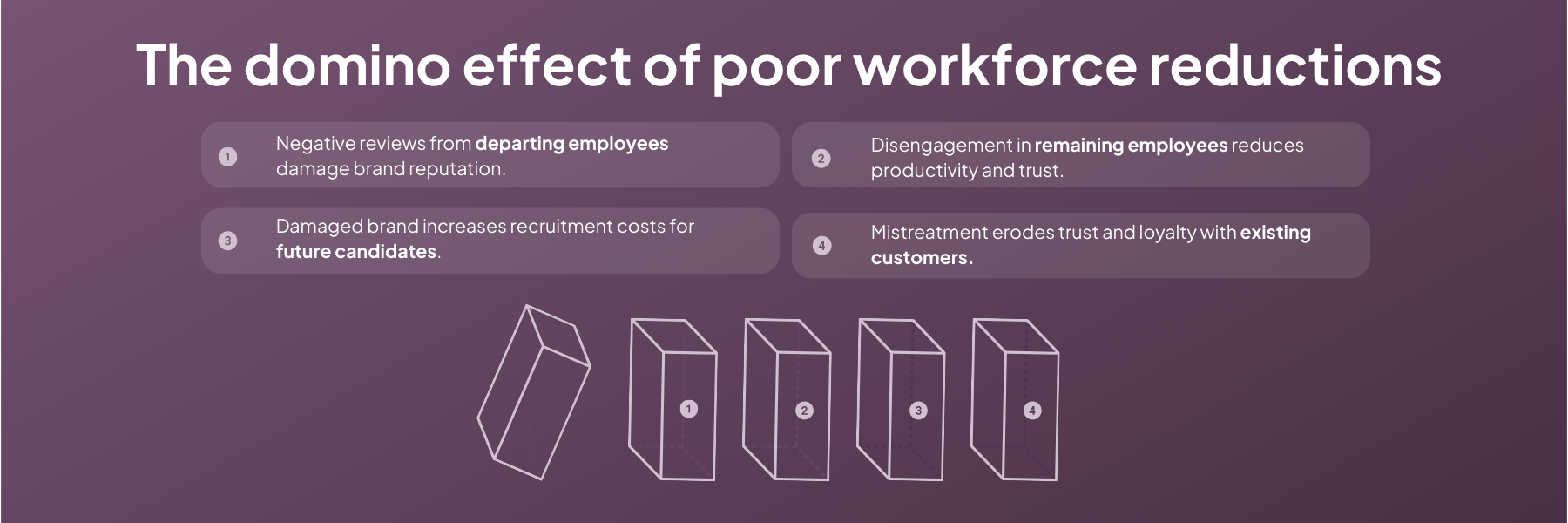
Departing Employees: Where it starts
Departing employees don’t disappear. They update their LinkedIn profiles, post on Glassdoor, text former colleagues, and occasionally vent to their networks. A single botched separation can become a PR crisis within hours.
The difference between a clean exit and a costly one rarely comes down to the decision itself. It comes down to execution. Treat people with dignity and meaningful support, not platitudes, and everyone notices.
Studies have shown that more than two thirds of consumers stop purchasing a brand after hearing news of poor employee treatment, which can lead to significant financial losses for the company.
Most of your effort belongs here. Get this right, and the downstream effects of reductions become much more manageable.
Remaining Workforce: The Quiet Collapse
Remaining employees watch how you treat those who leave. What they see shapes whether they stay engaged or start looking.
The numbers are unambiguous. Employees working in companies that lack adequate support for outgoing staff can experience a 20% decline in job satisfaction and a 41% decline in job performance. Each disengaged employee costs roughly 18% more than their annual salary in lost productivity. Multiply that across a recovering workforce, and projected savings evaporate.
But the damage goes deeper. According to studies, employees report diminished trust after watching a colleague get terminated and become less inclined to share ideas afterward.
This creates a cruel irony: the very people you need to drive recovery become the least likely to take risks or share ideas. Broken trust breeds resistance to the change your organization desperately seeks.
Future Recruits: The Brand Tax
After departing employees absorb the news and survivors draw their conclusions, candidates start paying attention. Reading employer reviews before applying is now standard practice.
A damaged employer brand extracts a premium. Research shows that companies with poor reputations pay up to 10% more to attract talent, up to $7 million annually for large organizations. That’s the cost of convincing candidates to overlook what they’ve read.
Voluntary departures spike 31% in the year following a workforce reduction. Your people are watching how you treat those you let go. Many decide the risk isn’t worth it.
You are now paying more to recruit while losing people you already trained. The math that once seemed simple starts working against you.
Consumer Brand: When Inside Bleeds Out
Your customers follow employee voices. Two thirds of consumers will choose competitors after hearing about employee mistreatment. Edelman’s Trust Barometer research shows that how a company treats its workforce ranks among the top drivers of consumer trust, alongside product quality and responsiveness to customer complaints.
The connection between internal decisions and external perception is direct. When consumers believe a company mistreats employees, overall trust drops. Edelman links this to lower willingness to buy, recommend, or defend your brand.
There’s also the operational spillover. As institutional knowledge departs and experienced frontline staff disappear, response times slow. Service quality slips. Reliability suffers. Customers may not immediately connect these problems to layoffs, but they respond by switching, complaining, or just buying less.
Authenticity Counts
If your post-layoff statement feels inauthentic, research shows 45% of consumers say their view of the company’s values worsens. Roughly 40% downgrade their view of leadership. The reputational damage spills directly into purchasing decisions.
We created the Leader’s Guide to Communicating Layoffs with Empathy to help prepare your leaders and your workforce for the transition ahead. It includes a step-by-step guide, checklists, and practical insights to help you manage the restructuring with empathy, dignity, and meaningful support for all your employees. How you say it matters as much as what you do.
The Compounding Effect
None of these figures show up in your balance sheet. They accumulate quietly through slower execution, knowledge walking out the door, a recruiting pipeline working against you, and customers taking their business elsewhere. Each cost feeds the next in a cycle that accelerates rather than fades.
Restructurings are inevitable in business. Treating people well during transitions is not. It’s a choice. Organizations that make that choice to support their departing employees in their transition and protect their remaining investment. We call it a win-win. Those that don’t spend years paying for it in ways the original projections never captured.
The way forward is simple: dignity, respect, and meaningful support for those departing. Start here, and the rest will follow.
Connect With Us
Select the option that best describes you so we can connect you with the right team.





Individual Support

Email Support

Employer Inquiry

Government Inquiry
